There is a story we tell ourselves about where modernity comes from. It goes something like this: the medieval world was a dark and stagnant place, shackled by superstition, until courageous Enlightenment thinkers broke free from the dead grasping hand of scholasticism and gave us science, markets, and progress.
It’s a tidy story. It’s also wrong.
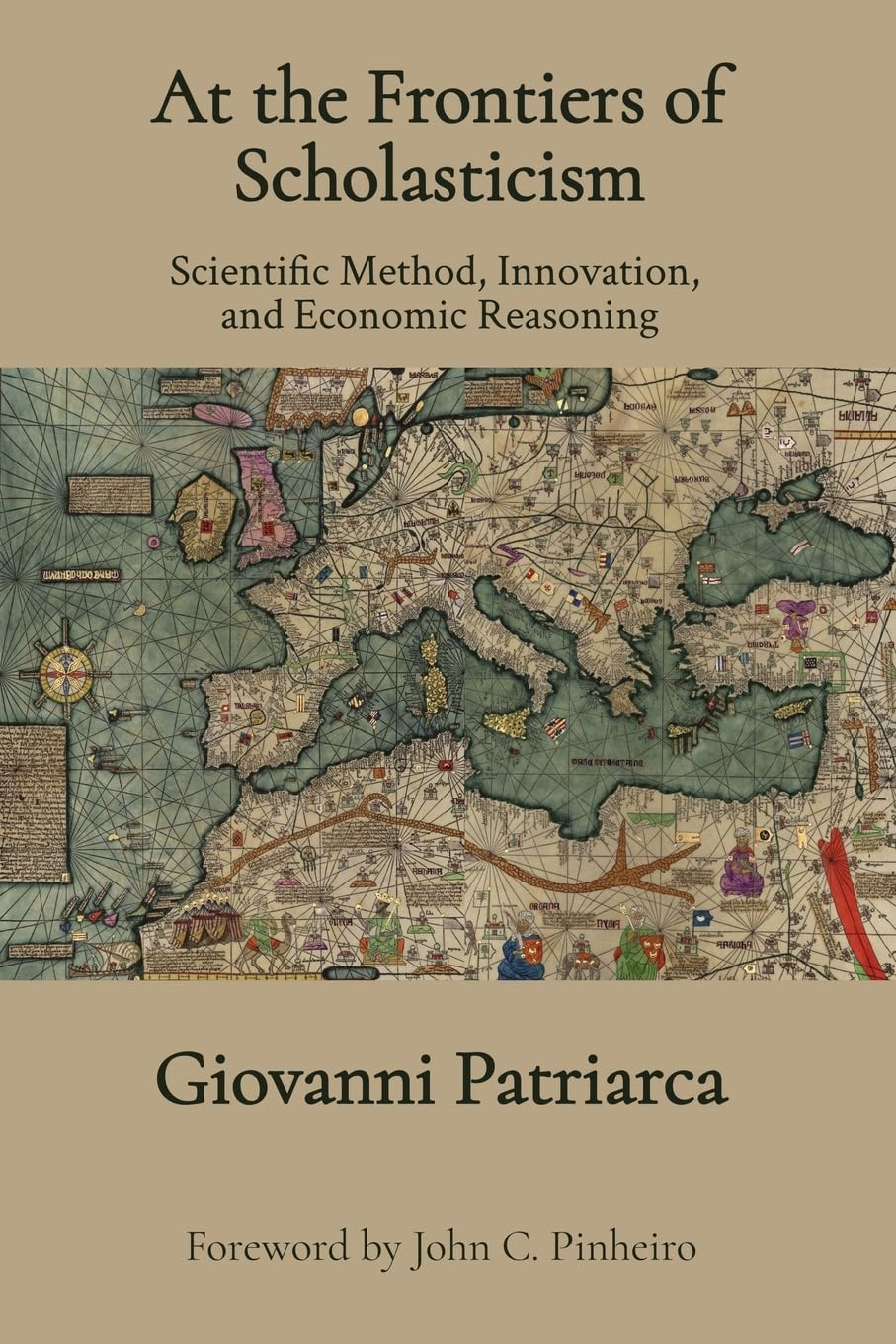
Giovanni Patriarca’s new book, At the Frontiers of Scholasticism: Scientific Method, Innovation, and Economic Reasoning, published by the Acton Institute, dismantles this myth with meticulous scholarship and genuine intellectual excitement. Across five richly researched essays, Patriarca shows that the foundations of the scientific method, modern mathematics, and economic reasoning were laid not in the secular Enlightenment but in the medieval universities, monasteries, and commercial centers of Europe by Franciscans, Dominicans, and Jesuits whose intellectual inquiry was inseparable from their vocations as men of faith.
The story begins in the thirteenth century, when the translation and dissemination of Greek, Arabic, and Jewish texts created the conditions for an unprecedented cultural flourishing. At Oxford, Robert Grosseteste was developing the controlled experiment and applying mathematics to the study of natural phenomena. His student Roger Bacon was championing the role of observation and experience. At Paris and across Europe, scholastic thinkers were engaging in disputatio (structured debate aimed not at winning arguments with elegant rhetoric but at arriving at truth).
Far from the rigid, ossified system of its popular caricature, scholasticism was a living tradition, dynamic and fertile. Patriarca traces its frontiers in every sense of the word. These frontiers were geographical spanning the trade routes from Normandy to the Italian Apennines, from the Mediterranean to the British Isles. They were intellectual pushing into uncharted territory opened up by new forms of commerce, banking, and international trade. And they were interreligious as Jewish, Christian, and Muslim thinkers exchanged ideas in mathematics and philosophy.
The economic dimension of the book is especially compelling. The roots of modern economic thought, Patriarca argues, are to be found not in Adam Smith or the Scottish Enlightenment but in the scholastic search for truth. The Hispanic Scholastics, the School of Salamanca, explored questions of price, value, and entrepreneurial innovation while applying moral reasoning to questions about trade, private property, and monetary policy. Patriarca furthers the Acton Institute’s important, longstanding project of studying, translating, and publishing the works of these pioneering thinkers.
One of the book’s most fascinating chapters examines Franciscan monetary theory. Another explores the Norman legal and commercial paradigm that helped give rise to the remarkable banking system of medieval Europe. Throughout, Patriarca conveys how these scholars sought to grasp the totality of truth in all its dimensions employing theology and philosophy as well as mathematics and the scientific method. For the scholastics, scientific and religious truth were not rivals but companions.
As John Pinheiro writes in his foreword, the “frontiers of scholasticism” were as geographical as they were intellectual: “Scholastic thinkers applied reason to the natural world because, as God’s creation, they knew it to be intelligible and bound by discoverable laws. Likewise, they applied this same rigor, in a synthesis of faith and reason, to human action.”
At a time when debates about science, economics, faith, and progress are as charged as ever, At the Frontiers of Scholasticism is a welcome reminder that the relationship between these domains has a richer and more fruitful history than we are usually told.
The book is already the #1 New Release in Medieval Western Philosophy on Amazon.
The ebook is available for preorder now: At the Frontiers of Scholasticism on Amazon
The paperback edition will be published and available on March 25, 2026.